Tag Archives: facts about cancer

CANCER: LUNG


SOURCE: Mayo Clinic

Lung Cancer

Diagnosis

Testing healthy people for lung cancer

People with an increased risk of lung cancer may consider annual lung cancer screening using low-dose CT scans. Lung cancer screening is generally offered to people 55 and older who smoked heavily for many years and are otherwise healthy.

Discuss your lung cancer risk with your doctor. Together you can decide whether lung cancer screening is right for you.

Tests to diagnose lung cancer

If there’s reason to think that you may have lung cancer, your doctor can order a number of tests to look for cancerous cells and to rule out other conditions.

Tests may include:

  • Imaging tests. An X-ray image of your lungs may reveal an abnormal mass or nodule. A CT scan can reveal small lesions in your lungs that might not be detected on an X-ray.
  • Sputum cytology. If you have a cough and are producing sputum, looking at the sputum under the microscope can sometimes reveal the presence of lung cancer cells.
  • Tissue sample (biopsy). A sample of abnormal cells may be removed in a procedure called a biopsy. Your doctor can perform a biopsy in a number of ways, including bronchoscopy, in which your doctor examines abnormal areas of your lungs using a lighted tube that’s passed down your throat and into your lungs; mediastinoscopy, in which an incision is made at the base of your neck and surgical tools are inserted behind your breastbone to take tissue samples from lymph nodes; and needle biopsy, in which your doctor uses X-ray or CT images to guide a needle through your chest wall and into the lung tissue to collect suspicious cells. A biopsy sample may also be taken from lymph nodes or other areas where cancer has spread, such as your liver.

Careful analysis of your cancer cells in a lab will reveal what type of lung cancer you have. Results of sophisticated testing can tell your doctor the specific characteristics of your cells that can help determine your prognosis and guide your treatment.

Tests to determine the extent of the cancer

Once your lung cancer has been diagnosed, your doctor will work to determine the extent (stage) of your cancer. Your cancer’s stage helps you and your doctor decide what treatment is most appropriate.

Staging tests may include imaging procedures that allow your doctor to look for evidence that cancer has spread beyond your lungs. These tests include CT, MRI, positron emission tomography (PET) and bone scans. Not every test is appropriate for every person, so talk with your doctor about which procedures are right for you.

The stages of lung cancer are indicated by Roman numerals that range from 0 to IV, with the lowest stages indicating cancer that is limited to the lung. By stage IV, the cancer is considered advanced and has spread to other areas of the body.

More Information

Treatment

  • Lung cancer surgery

You and your doctor choose a cancer treatment plan based on a number of factors, such as your overall health, the type and stage of your cancer, and your preferences.

In some cases, you may choose not to undergo treatment. For instance, you may feel that the side effects of treatment will outweigh the potential benefits. When that’s the case, your doctor may suggest comfort care to treat only the symptoms the cancer is causing, such as pain or shortness of breath.
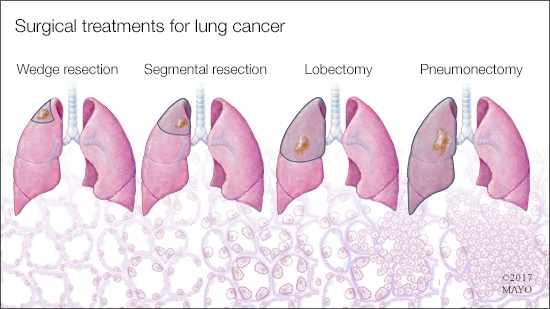
Surgery

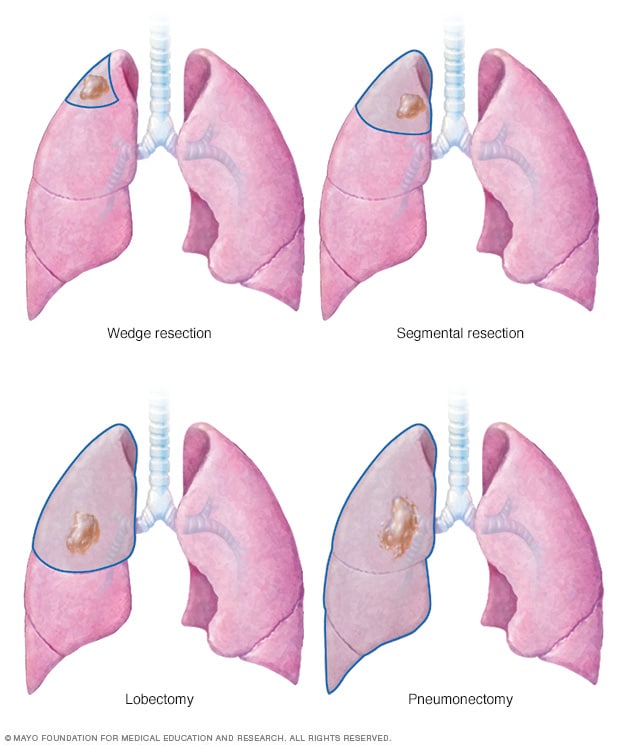
During surgery your surgeon works to remove the lung cancer and a margin of healthy tissue. Procedures to remove lung cancer include:

  • Wedge resection to remove a small section of lung that contains the tumor along with a margin of healthy tissue
  • Segmental resection to remove a larger portion of lung, but not an entire lobe
  • Lobectomy to remove the entire lobe of one lung
  • Pneumonectomy to remove an entire lung

If you undergo surgery, your surgeon may also remove lymph nodes from your chest in order to check them for signs of cancer.

Surgery may be an option if your cancer is confined to the lungs. If you have a larger lung cancer, your doctor may recommend chemotherapy or radiation therapy before surgery in order to shrink the cancer. If there’s a risk that cancer cells were left behind after surgery or that your cancer may recur, your doctor may recommend chemotherapy or radiation therapy after surgery.

Radiation therapy

Radiation therapy uses high-powered energy beams from sources such as X-rays and protons to kill cancer cells. During radiation therapy, you lie on a table while a machine moves around you, directing radiation to precise points on your body.

For people with locally advanced lung cancer, radiation may be used before surgery or after surgery. It’s often combined with chemotherapy treatments. If surgery isn’t an option, combined chemotherapy and radiation therapy may be your primary treatment.

For advanced lung cancers and those that have spread to other areas of the body, radiation therapy may help relieve symptoms, such as pain.

Chemotherapy

Chemotherapy uses drugs to kill cancer cells. One or more chemotherapy drugs may be given through a vein in your arm (intravenously) or taken orally. A combination of drugs usually is given in a series of treatments over a period of weeks or months, with breaks in between so that you can recover.

Chemotherapy is often used after surgery to kill any cancer cells that may remain. It can be used alone or combined with radiation therapy. Chemotherapy may also be used before surgery to shrink cancers and make them easier to remove.

In people with advanced lung cancer, chemotherapy can be used to relieve pain and other symptoms.

Radiosurgery

Stereotactic body radiotherapy, also known as radiosurgery, is an intense radiation treatment that aims many beams of radiation from many angles at the cancer. Stereotactic body radiotherapy treatment is typically completed in one or a few treatments.

Radiosurgery may be an option for people with small lung cancers who can’t undergo surgery. It may also be used to treat lung cancer that spreads to other parts of the body, including the brain.

Targeted drug therapy

Targeted drug treatments focus on specific abnormalities present within cancer cells. By blocking these abnormalities, targeted drug treatments can cause cancer cells to die.

Many targeted therapy drugs are used to treat lung cancer, though most are reserved for people with advanced or recurrent cancer.

Some targeted therapies only work in people whose cancer cells have certain genetic mutations. Your cancer cells may be tested in a laboratory to see if these drugs might help you.

Immunotherapy

Immunotherapy uses your immune system to fight cancer. Your body’s disease-fighting immune system may not attack your cancer because the cancer cells produce proteins that blind the immune system cells. Immunotherapy works by interfering with that process.

Immunotherapy treatments are generally reserved for people with advanced lung cancer.

Palliative care

People with lung cancer often experience signs and symptoms of the cancer, as well as side effects of treatment. Supportive care, also known as palliative care, is a specialty area of medicine that involves working with a doctor to minimize your signs and symptoms.

Your doctor may recommend that you meet with a palliative care team soon after your diagnosis to ensure that you’re comfortable during and after your cancer treatment.

In one study, people with advanced non-small cell lung cancer who began receiving supportive care soon after their diagnosis lived longer than those who continued with treatments, such as chemotherapy and radiation. Those receiving supportive care reported improved mood and quality of life. They survived, on average, almost three months longer than did those receiving standard care.

Lung Cancer Fact Sheet


Lung Cancer Fact Sheet

  • surpassed breast cancer Lung cancer is the leading cancer killer in both men and women in the U.S. In 1987, it to become the leading cause of cancer deaths in women.
  • An estimated 158,040 Americans are expected to die from lung cancer in 2015, accounting for approximately 27 percent of all cancer deaths.
  • The number of deaths caused by lung cancer has increased approximately 3.5 percent between 1999 and 2012 from 152,156 to 157,499. The number of deaths among men has plateaued but the number is still rising among women. In 2012, there were 86,740 deaths due to lung cancer in men and 70,759 in women.
  • The age-adjusted death rate for lung cancer is higher for men (56.1 per 100,000 persons) than for women (36.4 per 100,000 persons). It also is higher for blacks (48.3 per 100,000 persons) compared to whites (45.6 per 100,000 persons). Black men have a far higher age-adjusted lung cancer death rate than white men, while black and white women have similar rates.


Prevalence and Incidence

  • Approximately 402,326 Americans living today have been diagnosed with lung cancer at some point in their lives. 3
  • During 2015, an estimated 221,200 new cases of lung cancer were expected to be diagnosed, representing about 13 percent of all cancer diagnoses. 2
  • The majority of living lung cancer patients have been diagnosed within the last five years. Lung cancer is mostly a disease of the elderly. In 2011, 82 percent of those living with lung cancer were 60 years of age or older. 3
  • In 2011, Kentucky had the highest age-adjusted lung cancer incidence rates in both men (112.2 per 100,000) and women (79.3 per 100,000). Utah had the lowest age-adjusted cancer incidence rates in both men and women (34.5 per 100,000 and 25.0 per 100,000, respectively). 4 These state-specific rates were parallel to smoking prevalence rates.
  • Lung cancer is the most common cancer worldwide, accounting for 1.8 million new cases and 1.6 million deaths in 2012. 5
  • The National Institutes of Health estimate that cancer care cost the U.S. an overall $124.6 billion in 2010, $12.1 billion of which is due to lung cancer. Lost productivity due to early death from cancer lead to an additional $134.8 billion in 2005, $36.1 billion of which was caused by lung cancer. 6

Gender Differences

  • More men are diagnosed with lung cancer each year, but more women live with the disease. The rate of new cases in 2011 showed that men develop lung cancer more often than women (64.8 and 48.6 per 100,000, respectively). 3
  • The rate of new lung cancer cases (incidence) over the past 37 years has dropped for men (28 percent decrease), while it has risen for women (98 percent increase). In 1975, rates were low for women, but rising for both men and women. In 1984, the rate of new cases for men peaked (102.1 per 100,000) and then began declining. The rate of new cases for women increased further, did not peak until 1998 (52.9 per 100,000), and has now started to decline.3

http://www.youtube.com/watch?v=Out098oAdxs


Racial/Ethnic Differences

  • Blacks are more likely to develop and die from lung cancer than persons of any other racial or ethnic group. The age-adjusted lung cancer incidence rate among black men is approximately 32 percent higher than for white men, even though their overall exposure to cigarette smoke, the primary risk factor for lung cancer, is lower. 3, 7
  • The lung cancer incidence rate for black women is roughly equal to that of white women, despite the fact that they smoke fewer cigarettes. 3, 7

Survival Rates

  • The lung cancer five-year survival rate (17.8 percent) is lower than many other leading cancer sites, such as the colon (65.4 percent), breast (90.5 percent) and prostate (99.6 percent). 3
  • The five-year survival rate for lung cancer is 54 percent for cases detected when the disease is still localized (within the lungs). However, only 15 percent of lung cancer cases are diagnosed at an early stage. For distant tumors (spread to other organs) the five-year survival rate is only 4 percent. 3
  • More than half of people with lung cancer die within one year of being diagnosed. 3


Smoking-Attributable Lung Cancer

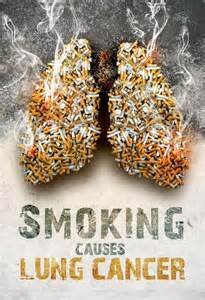
  • Smoking, a main cause of small cell and non-small cell lung cancer, contributes to 80 percent and 90 percent of lung cancer deaths in women and men, respectively. Men who smoke are 23 times more likely to develop lung cancer. Women are 13 times more likely, compared to never smokers. 8
  • Between 2005 and 2010, an average of 130,659 Americans (74,300 men and 56,359 women) died of smoking-attributable lung cancer each year. Exposure to secondhand smoke causes approximately 7,330 lung cancer deaths among nonsmokers every year. 9
  • Nonsmokers have a 20 to 30 percent greater chance of developing lung cancer if they are exposed to secondhand smoke at home or work. 10

Other Causes

  • It has been estimated that active smoking is responsible for close to 90 percent of lung cancer cases; radon causes 10 percent, occupational exposures to carcinogens account for approximately 9 to 15 percent and outdoor air pollution 1 to 2 percent. Because of the interactions between exposures, the combined attributable risk for lung cancer can exceed 100 percent. 11
  • Exposure to radon is estimated to be the second-leading cause of lung cancer, accounting for an estimated 21,000 lung cancer deaths each year (range of 8,000 to 45,000). Radon is a tasteless, colorless and odorless gas that is produced by decaying uranium and occurs naturally in soil and rock. The majority of these deaths occur among smokers since there is a greater risk for lung cancer when smokers also are exposed to radon. 12
  • Lung cancer can also be caused by occupational exposures, including asbestos, uranium and coke (an important fuel in the manufacture of iron in smelters, blast furnaces and foundries). The combination of asbestos exposure and smoking greatly increases the risk of developing lung cancer. 13
  • Nonsmoking asbes­tos workers are five times more likely to develop lung cancer than non­smokers not ex­posed to asbestos; if they also smoke, the risk factor jumps to 50 or higher. 11 Environmental exposures also can increase the risk of lung cancer death. 14

For More Information on Lung Cancer Research @ Mayo Clinic


For more information on lung cancer, please review the Lung Cancer Morbidity and Mortality Trend Report at www.lung.org or call the American Lung Association at1-800-LUNG-USA (1-800-586-4872).

  • Sources
    1. Centers for Disease Control and Prevention. National Center for Health Statistics. CDC WONDER On-line Database, compiled from Compressed Mortality File 1999-2012 Series 20 No. 2R, 2014.
    2. American Cancer Society. Cancer Facts and Figures, 2015.
    3. S. National Institutes of Health. National Cancer Institute. SEER Cancer Statistics Review, 1975-2011.
    4. S. National Institutes of Health. National Cancer Institute. State Cancer Profiles ;web tool, accessed October 6, 2014.
    5. World Health Organization. International Agency for Research on Cancer. GLOBOCAN 2012: Estimated Cancer Incidence, Mortality and Prevalence Worldwide in 2012. Lung Cancer. Accessed November 10, 2014.
    6. S. National Institutes of Health. National Cancer Institute. Cancer Trends Progress Report – 2011/2012 Update. Costs of Cancer Care.
    7. Centers for Disease Control and Prevention. National Center for Health Statistics. National Health Interview Survey, 2010. Analysis by the American Lung Association, Research and Program Services Division using SPSS software.
    8. The Health Consequences of Smoking: A Report of the U.S. Surgeon General, 2004.
    9. S. Department of Health and Human Services. The Health Consequences of Smoking—50 Years of Progress: A Report of the Surgeon General, 2014.
    10. S. Department of Health and Human Services. The Health Consequences of Involuntary Exposure to Tobacco Smoke: A Report of the Surgeon General, 2006.
    11. Alberg AJ, Samet JM. Epidemiology of Lung Cancer. Chest. 2003; 123:21-49.
    12. S. Environmental Protection Agency. A Citizen’s Guide to Radon. January 2013.
    13. S. Department of Health and Human Services. National Toxicology Program. 12th Report on Carcinogens (RoC). June 10, 2011.
    14. Jerrett M, et al. Spatial Analysis of Air Pollution and Mortality in Los Angeles. Epidemiology. November 2005; 16(6):727-36.

*Racial and ethnic minority terminology reflects those terms used by the Centers For Disease Control.

Save

SavMayo Clinic information Link for Lung Cancer